Real Estate Private Equity: 2026 Strategic Guide
30 August 2026U.S. private equity dry powder reached $1.13 trillion in mid-2026, yet the path to securing a high-value real estate private equity investment is increasingly governed by technical precision rather than mere availability. You’ve likely seen how inflationary pressures and shifting regulations, such as the 21st Century ROAD to Housing Act, have tightened the requirements for institutional-grade capital. It’s clear that the traditional gap between capital providers and operational developers often erodes margins before the first stone is even laid.
This guide offers the strategic clarity needed to bridge that divide and master the complexities of modern property finance. We’ll show you how to align with sophisticated partners to drive growth and protect your project’s lifecycle. We’ll explore the rise of evergreen funds, the impact of AI on asset selection, and why an integrated, operational approach is now the standard for securing global capital in a higher-for-longer interest rate environment. By replacing passive capital with lifecycle-managed partnerships, you can transform complex cross-border challenges into stable, high-yield assets.
Key Takeaways
- Analyze the transition from public markets to high-conviction private partnerships to secure institutional-grade stability.
- Optimize your real estate private equity investment by strategically structuring the 2026 capital stack across senior debt and common equity.
- De-risk large-scale developments by adopting an integrated design-and-build model that aligns operational expertise with capital objectives.
- Identify resilient thematic sectors, such as mixed-use ecosystems, that offer long-term structural tailwinds for global development.
- Evaluate international finance partners based on their track record in managing complex, cross-border project lifecycles and institutional scaling.
Defining Real Estate Private Equity Investment in the 2026 Landscape
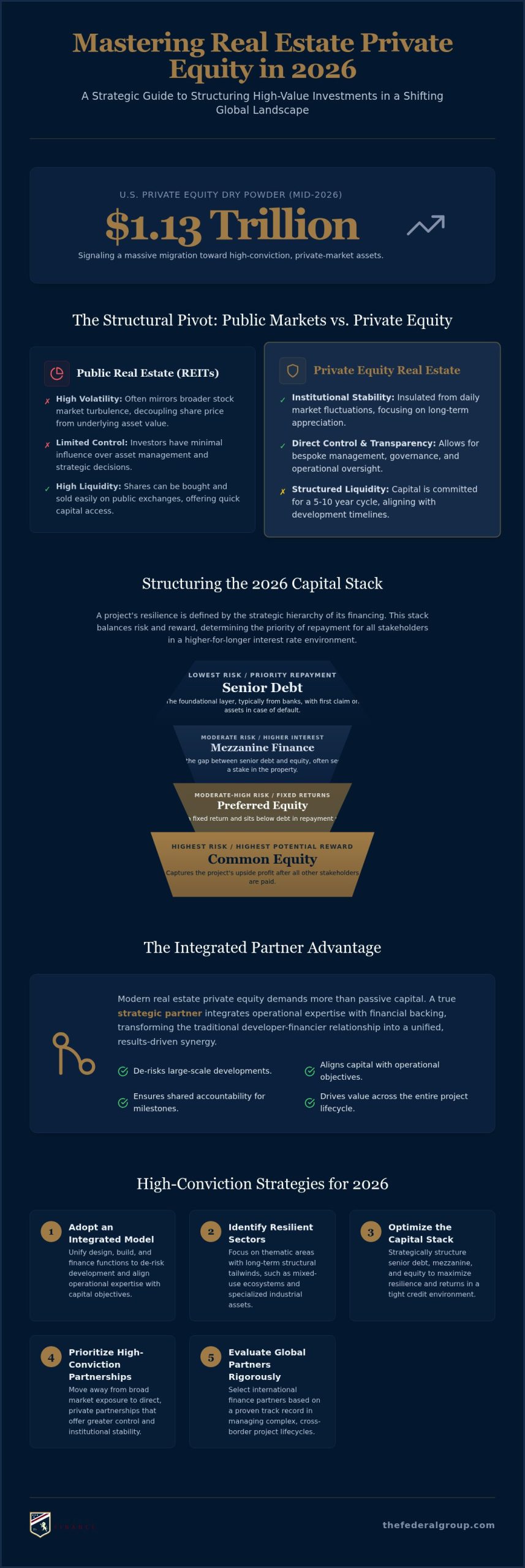
Institutional portfolios are undergoing a structural pivot. By mid-2026, U.S. private equity dry powder hit a staggering $1.13 trillion, signaling a massive migration toward high-conviction, private-market assets. This shift defines the current real estate private equity investment climate. Sophisticated investors are moving away from the volatility of public markets to find refuge in direct asset ownership. This transition isn’t merely about capital preservation; it’s about securing a position in an ecosystem where operational control and technical precision drive value.
Private Equity vs. Public Real Estate Vehicles
Publicly traded REITs often mirror the turbulence of the broader stock market, which can decouple a property’s share price from its underlying value. Private equity real estate offers a more stable alternative for high-stakes stakeholders. While public vehicles provide liquidity, private equity prioritizes transparency and direct control over the asset’s lifecycle.
- Volatility: Private markets are insulated from daily ticker fluctuations, focusing on long-term appreciation and steady income.
- Transparency and Control: Direct equity allows for bespoke management strategies and governance that public shares cannot offer.
- Liquidity Profiles: Most partnerships operate on a 5-10 year commitment cycle, aligning capital with the time required for institutional-grade development.
The Role of the Real Estate Private Equity Partner
A modern partnership goes far beyond a simple infusion of liquidity. Today’s developers require a strategic ally that understands the intricacies of cross-border finance and the logistical demands of a integrated design and build developer model. This proactive approach de-risks projects by ensuring that the financier is as invested in construction milestones as they are in the final exit. It replaces passive allocation with a results-driven synergy.
A Real Estate Private Equity Partner acts as a specialized catalyst for scaling international portfolios through technical precision and shared operational accountability.
The benefits of a well-executed real estate private equity investment are especially pronounced in 2026. With the global commercial real estate market projected to reach $702.99 billion by 2035, the ability to hedge against inflation through tangible assets is paramount. These partnerships offer capital appreciation and risk-adjusted returns that consistently outperform passive models. By selecting an international real estate finance partner with deep sector expertise, developers can navigate regulatory shifts like the 21st Century ROAD to Housing Act while maintaining institutional-grade growth across global markets.
Structuring the Investment: The 2026 Capital Stack
Structuring a high-value real estate private equity investment requires a meticulous approach to the capital stack. This hierarchy defines the priority of repayment and the distribution of risk across all stakeholders. At the base, senior debt provides the foundation, offering the lowest risk and priority for repayment. Mezzanine finance fills the intermediate gap, while equity sits at the top, bearing the most risk but capturing the highest potential rewards. For a technical breakdown of debt layers, review our guide on international property development finance.
Strategic placement within this stack determines a project’s resilience. In 2026, maximizing leverage isn’t about taking on excessive debt; it’s about optimizing the blend of capital to maintain liquidity. With U.S. commercial real estate investment volume rising 19% year-over-year in the first quarter of 2026, the demand for sophisticated structuring has reached a new peak. Developers must balance debt-to-equity ratios to withstand the higher-for-longer interest rate environment while ensuring enough “skin in the game” to satisfy institutional partners.
Equity Finance for Property Development
Equity isn’t a monolith. Preferred equity provides a fixed return and sits just below debt in the repayment order, offering a safety net for investors. Common equity, however, captures the project’s “blue sky” upside. Successful Joint Ventures (JVs) for large-scale commercial projects rely on aligning these incentives. We’ve found that the most stable structures use tiered waterfall schedules. These ensure that the operational developer is rewarded for outperformance while the capital provider’s principal remains protected.
The Synergy of Bridging Loans and Private Equity
Bridging finance is the tactical precursor to long-term equity deployment. In a fast-moving market, waiting for full private equity committee approval can cost you a prime site. Using bridging finance for land acquisition allows you to move with the speed of a cash buyer. Once the site is secured and planning is de-risked, the real estate private equity investment can be layered in to replace the short-term debt. This integrated flow prevents project stagnation and maintains development momentum.
This synergy is particularly effective for mixed-use developments where land costs are substantial. Short-term capital solutions bridge the gap between acquisition and the commencement of the main construction phase. It’s a method that provides the agility of a niche consultancy with the scale of a global corporation. Partnering with a strategic finance partner that understands this transition is essential for securing institutional-grade growth in complex markets.
The Integrated Advantage: Why Operational Expertise Outperforms Pure Capital
Passive capital is no longer the primary driver of alpha in the 2026 property market. As dry powder remains at record levels, the differentiator for a successful real estate private equity investment has shifted from the size of the check to the depth of operational involvement. The traditional siloed relationship between a funder and a developer often creates friction, leading to misaligned incentives and eroded margins. By contrast, the rise of the integrated developer-financier ensures that capital is deployed with the surgical precision of an active participant.
The Federal Group’s Federal Holdings division serves as a blueprint for this efficiency. By acting as an integrated design and build developer, the firm eliminates the disconnect between the boardroom and the construction site. This model de-risks the project lifecycle by managing every variable from the initial architectural vision to the final asset disposal. This holistic approach ensures that high-value stakeholders aren’t just financing a project; they’re investing in a managed ecosystem designed for stability and institutional-grade growth.
Streamlining the Development Lifecycle
Vertical integration allows architectural design and construction management to function as core equity pillars rather than external services. When the financier maintains direct oversight, real-time decision-making replaces the weeks of bureaucracy typical of third-party consulting. This efficiency is achieved through several strategic advantages:
- Supply Chain Control: Direct procurement reduces exposure to global material price volatility.
- Design-Build Synergy: Eliminating the friction between designers and contractors prevents costly mid-build revisions.
- Lifecycle Oversight: Managing every stage from land acquisition to asset disposal ensures capital is optimized at every milestone.
Industry data suggests that these integrated models can reduce typical project timelines by approximately 20% compared to fragmented delivery methods. This acceleration directly enhances ROI by reducing carrying costs and enabling faster capital rotation.
Risk Mitigation in International Markets
Operating in volatile global markets requires more than just a large balance sheet. It demands a partner capable of navigating complex cross-border regulations and ensuring supply chain resilience through direct control. Vertically integrated development provides a buffer against the inflationary pressures on construction costs that currently erode margins for passive investors. Specialized capital solutions, when paired with local technical expertise, allow developers to scale with confidence. This strategy transforms a standard real estate private equity investment into a resilient, lifecycle-managed partnership that can withstand shifting regulatory landscapes and economic headwinds.
High-Conviction Sectors for Private Equity Investment in 2026
Thematic investing has become the cornerstone of a sophisticated real estate private equity investment strategy. As we move through 2026, the most successful portfolios are those that identify and capitalize on long-term structural tailwinds rather than chasing broad market recovery. Mixed-use developments have emerged as particularly resilient, creating “live-work-play” ecosystems that offer built-in diversification. These projects mitigate the risks associated with single-sector downturns by balancing residential demand with commercial and retail vitality. Commercial real estate prices across all sectors rose 2.1% in March 2026, yet the highest growth is concentrated in assets that support modern infrastructure.
Logistics and industrial sectors continue to anchor global portfolios, supported by the relentless expansion of e-commerce. Total U.S. CRE investment volume rose 19% year-over-year to $117.3 billion in the first quarter of 2026, with a significant portion of this capital flowing into data centers. The demand for digital infrastructure is projected to reach an all-time high this year, driven by the rapid integration of AI across all business sectors. These operationally intensive assets require a level of technical precision that only an integrated finance and development partner can provide.
Sports Multi-Club Ownership as a Real Estate Strategy
A significant shift in 2026 is the convergence of professional sports and institutional property development. Private equity partners are increasingly viewing professional football clubs as anchor assets for large-scale urban regeneration. This strategy uses the club’s brand and stadium as a catalyst for surrounding commercial, residential, and hospitality projects. The synergy creates a captive audience and ensures consistent footfall, de-risking the broader development. Mastering the financial structuring for multi-club ownership is now a vital skill for developers looking to scale this emerging asset class.
Sustainable and ESG-Driven Development
Green building standards are no longer a secondary consideration for private equity partners. They’re a mandatory requirement for securing institutional exit capital. High-value stakeholders recognize that energy-efficient design is a core value-driver that future-proofs an asset against shifting regulations. This focus on sustainability isn’t just about ethics; it’s about maximizing ROI. Institutional buyers prioritize ESG-compliant assets, meaning that sustainable design significantly enhances a project’s liquidity and terminal value on the secondary market.
To capitalize on these high-conviction sectors, you need an international real estate finance partner with the specialized expertise to manage multi-disciplinary portfolios. This integrated approach ensures that your capital is always aligned with the most resilient market opportunities.
Selecting an International Real Estate Finance Partner
Selecting a partner for a real estate private equity investment is a decision that defines a decade of project governance. It’s a high-stakes alignment of vision and technical capability. In a market where global commercial real estate is expanding toward a projected $702.99 billion valuation by 2035, the difference between a standard lender and a strategic ally is the ability to navigate cross-border complexity. You need a partner that doesn’t just allocate funds but understands the visionary energy required for industrial-scale development.
Due diligence must extend beyond the balance sheet. It involves evaluating a partner’s proven track record in managing integrated project lifecycles. A sophisticated international real estate finance partner provides the stability needed for global scaling. This ensures your portfolio remains resilient against regional regulatory shifts or economic volatility, such as the interest rate pressures observed throughout the first half of 2026.
Checklist for Private Equity Partnership
Developers should utilize a structured framework when vetting potential equity partners. This ensures that the partnership can withstand the pressures of a long-term commitment cycle. Focus on these three pillars:
- Operational Depth: Does the partner offer integrated design and build capabilities, or are they a passive capital pool?
- Cross-Border Expertise: Can they manage the legal and financial nuances of international development finance and bridging loans?
- Lifecycle Governance: Are they equipped to oversee a project from land acquisition through to institutional exit?
Partnering with The Federal Group
The Federal Group operates as a connector of opportunities. We combine the scale of a global corporation with the specialized insight of a niche consultancy. Our Federal Holdings division offers a vertically integrated model that removes the traditional friction between funder and developer. Meanwhile, our Sports Division identifies unique synergies between professional football infrastructure and urban regeneration, providing anchor assets that de-risk surrounding commercial projects.
This multi-disciplinary approach allows us to manage every stage of a project’s lifecycle with technical precision. By aligning with a partner that understands both the gravity of institutional finance and the momentum of large-scale development, you secure a pathway to consistent growth. Contact our team to discuss how our solutions as a development finance lender can support your next high-value international venture.
Future-Proofing Your Global Property Portfolio
The 2026 property landscape demands more than passive capital. It requires a technical synergy between high-level finance and operational execution. A robust real estate private equity investment strategy relies on a sophisticated capital stack and the selection of high-conviction sectors like mixed-use ecosystems or sports-anchored urban regeneration. Transitioning from a pure allocator to an integrated operator is now the standard for de-risking international portfolios and securing institutional-grade returns.
The Federal Group provides the established authority and specialized expertise needed to navigate these multi-disciplinary challenges. Through Federal Holdings, we deliver fully integrated design-and-build capabilities that streamline the development lifecycle from architectural vision to final disposal. Our specialized Sports Division offers visionary multi-club ownership strategies that create resilient, high-value anchor assets for complex urban projects. Partner with The Federal Group for Strategic Private Equity Investment to leverage our global footprint and drive development growth. It’s time to align your vision with a partner possessing the scale and insight to deliver results in a complex global market.
Frequently Asked Questions
What is the typical minimum investment for real estate private equity?
Minimum investment thresholds for institutional-grade real estate private equity investment typically vary based on the specific fund strategy and the scale of the underlying assets. While retail platforms offer lower entry points, high-value partnerships usually require a significant capital commitment from limited partners. These thresholds ensure that all stakeholders possess the liquidity and risk tolerance necessary for long-term, industrial-scale development cycles across global markets.
How do real estate private equity funds generate returns for investors?
Returns are primarily generated through a combination of consistent rental income and capital appreciation upon the asset’s exit. In development-heavy strategies, value is created by transforming raw land or underutilized sites into institutional-grade properties. Private equity partners often utilize tiered waterfall structures. These prioritize the return of principal to investors before distributing surplus profits based on pre-negotiated performance milestones and operational success.
What are the primary risks associated with private equity for property developers?
Developers face risks such as construction cost inflation, regulatory shifts, and interest rate volatility. Misalignment between the capital provider and the operator can also lead to project stagnation if incentives aren’t properly structured. In 2026, the higher-for-longer interest rate environment remains a critical factor. It directly impacts both the cost of debt and the terminal cap rates used for asset valuation at exit.
How does a joint venture differ from a traditional private equity partnership?
A joint venture is typically a project-specific arrangement where the developer and financier share direct oversight and risk for a single asset. A traditional private equity partnership often involves limited partners committing capital to a broader fund managed by a General Partner. JVs offer more transparency and control for the developer. This makes them ideal for complex, large-scale international projects requiring high-conviction operational synergy.
Can bridging finance be used alongside private equity investment?
Bridging finance is frequently used as a tactical precursor to long-term equity deployment. Developers utilize short-term bridging loans to secure prime sites or distressed assets quickly before the full private equity committee approval is finalized. This synergy ensures that development momentum is maintained during the acquisition phase. Once the project is de-risked, the bridge debt is typically refinanced or replaced by a permanent real estate private equity investment.
What sectors are currently seeing the highest private equity allocation in 2026?
In 2026, institutional capital is heavily rotating toward infrastructure-adjacent sectors. Data centers are seeing record demand due to the rapid integration of AI, while logistics and industrial assets remain resilient. Additionally, mixed-use “live-work-play” ecosystems and the convergence of professional sports infrastructure with commercial real estate are emerging as high-conviction areas. These sectors offer structural tailwinds that provide stability despite broader market fluctuations.
How does the ‘integrated developer’ model impact investment risk?
The integrated developer model significantly reduces risk by eliminating the traditional friction between the funder and the construction manager. When a partner manages the full project lifecycle, from architectural design to build, they maintain direct oversight of the supply chain and timelines. This vertical integration buffers the project against inflationary pressures. It ensures that operational decisions are always aligned with the capital provider’s financial objectives and risk profile.
What should a developer look for in an international finance partner?
Developers should prioritize partners with a proven global footprint and specific expertise in cross-border regulatory environments. A strategic partner must offer more than capital; they should possess the operational depth to understand the nuances of international property development. Look for a firm that manages the entire lifecycle and demonstrates stability in high-stakes environments. This ensures they can scale alongside your portfolio across different jurisdictions and market cycles.