Strategic Exit Strategies for Property Development Finance in 2026
5 September 2026In 2026, the most significant risk to a project isn’t the construction phase; it’s the failure to pre-engineer a liquid exit before the first spade hits the ground. To secure high-value institutional backing, your exit strategies for property development finance must function as a core structural component rather than a final destination. You’re likely already feeling the pressure of the current viability squeeze, where tender prices are forecast to rise by 3.0% and new regulations like the Future Homes Standard redefine asset requirements. This isn’t a market for the reactive. It’s a market for those who understand how to integrate financial liquidity into the design and build process from day one.
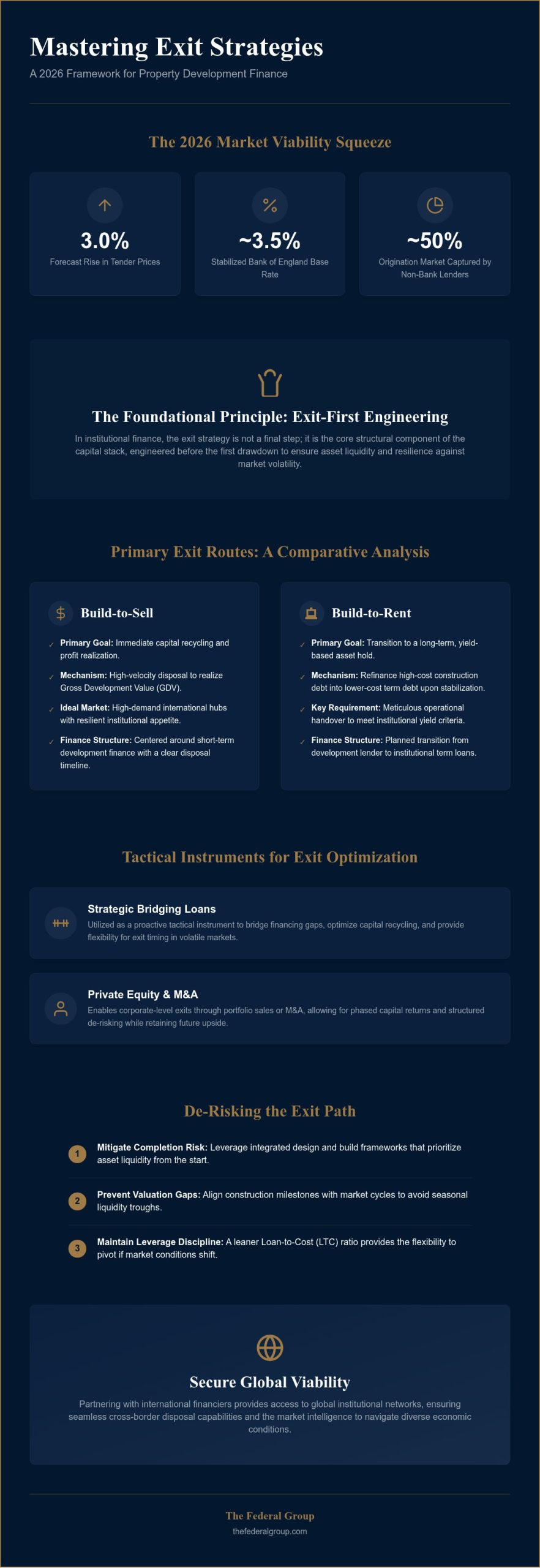
This article provides the strategic framework needed to master these complex exit pathways, ensuring you protect your IRR and maintain momentum in a volatile global market. We’ll examine how to reduce refinancing risk through integrated project delivery and the use of strategic bridging tools to optimize capital recycling. By the end of this analysis, you’ll have a clear roadmap to navigate the transition from construction finance to long-term debt or disposal, even as the Bank of England base rate stabilizes around 3.5% and non-bank lenders continue to capture nearly half of the origination market.
Key Takeaways
- Define the exit path at the origination stage to ensure capital structures remain resilient against 2026 market volatility.
- Analyze the distinct advantages of Build-to-Sell versus Build-to-Rent models to implement the most effective exit strategies for property development finance.
- Utilize bridging loans and private equity as proactive tactical instruments to optimize capital recycling and exit timing.
- Mitigate completion risk and prevent valuation gaps by leveraging integrated design and build frameworks that prioritize asset liquidity.
- Partner with international financiers to access global institutional networks and ensure seamless cross-border disposal capabilities.
Planning the Exit at Origination: Why Strategy Dictates Capital Structure
In high-stakes institutional finance, an exit strategy isn’t a contingency; it’s the foundation of the capital stack. We define the exit strategy as the pre-meditated, data-driven path to capital repayment and profit realization. Without a clearly articulated exit, development finance becomes a liability rather than a tool for growth. In the 2026 market, where the Bank of England base rate is expected to hover around 3.5%, sophisticated developers recognize that exit strategies for property development finance must be engineered before the first drawdown occurs. A Strategic Exit is a multi-layered plan that aligns debt maturity with asset liquidity.
Market volatility in 2026, characterized by a 3.0% forecast in tender price inflation, necessitates multiple contingency paths. Relying on a single disposal route is no longer viable for large-scale projects. We see a direct relationship between exit viability and initial loan-to-cost (LTC) ratios. While lenders may advance up to 85% or 90% of total project costs, higher leverage narrows the window for a successful exit. A leaner LTC provides the breathing room required to pivot if market liquidity shifts during the construction phase.
Reverse-Engineering the Development Lifecycle
Successful developers start with the end-user. Whether the target is an institutional Build-to-Rent (BTR) fund or individual residential buyers, the profile of the eventual occupant dictates the finance structure. We align construction milestones with anticipated market cycles to ensure that asset completion doesn’t coincide with seasonal liquidity troughs. Choosing a strategic real estate finance partner means engaging with a specialist who understands that exit planning begins at day one. This proactive approach ensures that every development phase builds toward a seamless capital transition.
The Role of Market Intelligence in Exit Forecasting
Global data is essential for predicting regional liquidity shifts. In 2026, the stabilization of interest rates has a profound impact on cap rates; understanding this delta is crucial for accurate Gross Development Value (GDV) forecasting. Developers must assess how these trends influence the appetite of institutional buyers across different jurisdictions. For those operating on a global scale, leveraging international property development finance provides the necessary breadth to navigate diverse market conditions. This intelligence allows for the adjustment of exit strategies for property development finance in real-time, ensuring that the project remains attractive to the most liquid pools of capital at any given moment.
Primary Exit Routes in 2026: Market Sales vs. Long-Term Refinancing
The decision between liquidating an asset or transitioning to a yield-based hold is the pivotal moment in a project’s lifecycle. In 2026, exit strategies for property development finance are increasingly split between high-velocity disposal in Tier 1 hubs and the long-term Build-to-Rent (BTR) hold. For developers targeting immediate capital recycling, the “Build-to-Sell” model remains the primary vehicle for realizing Gross Development Value (GDV). This path is particularly effective in high-demand international hubs where institutional appetite for premium residential and commercial stock remains resilient despite broader economic shifts.
Conversely, the “Build-to-Rent” transition allows developers to move from high-cost construction finance into lower-cost term debt once the asset is stabilized. This shift requires a meticulous operational handover to ensure the property meets the stringent yield requirements of institutional investors. Beyond asset-level disposals, we’re seeing an uptick in corporate-level exits, where portfolio sales or M&A activity allow developers to exit entire platforms. This approach often involves partial exits and phased capital returns, providing a structured way to de-risk while maintaining an interest in future upside through managed equity stakes.
The Refinance Path: Securing Senior Debt
Transitioning from a development finance lender to institutional term loans is a rigorous process in the 2026 lending environment. Lenders prioritize the Debt Service Coverage Ratio (DSCR), often requiring it to be above 1.25x for stabilized assets. Managing the stabilization period-the gap between construction completion and full occupancy-is critical. Developers often utilize short-term bridging tools to cover this window, ensuring that the project doesn’t face penalty interest while building the rent roll. For those seeking to optimize this transition, engaging with an integrated finance partner ensures that the debt structure remains flexible enough to accommodate shifting occupancy timelines.
Specialized Asset Exits: Sports and Infrastructure
Niche asset classes require bespoke liquidity frameworks that traditional commercial models often overlook. Exit strategies for multi-club ownership models and sports infrastructure involve realizing value through mixed-use stadium developments and integrated media rights. Unlike traditional real estate, these exits are frequently powered by private equity alignment that values the entire ecosystem of the brand alongside the physical property. This patient capital allows for longer horizons, ensuring that the infrastructure is fully operational and revenue-generating before a disposal or refinancing event is triggered. In these high-stakes environments, the exit is often a multi-stage process involving both asset refinancing and the sale of minority equity tranches.
Tactical Exit Instruments: Leveraging Bridging Loans and Private Equity
In a volatile global market, the tools used to bridge the gap between construction and disposal are as critical as the primary loan itself. We reposition bridging finance not as a last-resort safety net, but as a proactive “Bridge-to-Exit” instrument. This tactical shift allows developers to decouple the physical completion of a project from the financial pressure of immediate disposal. By using these instruments, sophisticated operators can refine their exit strategies for property development finance, ensuring they don’t sell into a temporary market dip. Layering mezzanine debt further protects common equity, providing a buffer that maintains project momentum even when senior debt markets tighten.
Capital versatility is the hallmark of the 2026 cycle. With tender price inflation and shifting interest rates, the ability to pivot between debt types is essential. This flexibility ensures that the developer remains in control of the timeline, rather than being forced into an exit by an expiring loan facility. Key advantages include:
- Equity Protection: Mezzanine layers absorb market shocks without diluting original equity stakes.
- Timeline Control: Bridging instruments prevent forced liquidations during periods of low market liquidity.
- Yield Optimization: Patient capital allows for the full maturation of rental yields before a refinance event.
Strategic Bridging Finance for Exit Timing
Proactive timing is the difference between a standard return and a superior IRR. Utilizing bridging finance for land acquisition or late-stage completion allows developers to control the development timeline from the outset. Short-term capital provides a strategic window to wait for peak market conditions or to complete the stabilization of a commercial asset. We frequently see the “Bridge-to-Let” model used for commercial portfolios, where bridging debt covers the period required to secure long-term tenants before transitioning to institutional term loans.
Private Equity Alignment and Waterfall Structures
Private equity brings a level of “Patient Capital” that traditional bank debt cannot match. Understanding the strategic role of a real estate private equity partner is vital for large-scale developments where the exit horizon may span several years. These partnerships are defined by sophisticated waterfall structures that align interests through preferred returns and common equity splits. Co-investment models are particularly effective; when your finance partner has “skin in the game,” the focus remains squarely on optimizing the exit value. This alignment ensures that every decision made during the development lifecycle is viewed through the lens of long-term asset liquidity and capital realization.
De-risking the Exit Path: The Impact of Integrated Design and Build
Liquidity is engineered, not discovered. For institutional investors and senior lenders, the physical integrity and operational efficiency of an asset are the primary indicators of exit viability. When the design and construction phases are siloed, a “valuation gap” frequently emerges at completion, where the final product fails to meet the yield requirements of 2026 buyers. This misalignment is the single greatest threat to exit strategies for property development finance. By integrating these disciplines, developers ensure that architectural excellence serves as a direct driver of asset liquidity rather than a purely aesthetic consideration.
Technical due diligence is often the friction point where sales or refinancing agreements falter. An integrated approach provides a transparent, end-to-end data trail that simplifies the scrutiny of institutional buyers. This precision removes the “Developer Risk Premium” that often depresses valuations in fragmented projects. Crucially, integrated development reduces the risk of cost overruns that threaten the exit IRR, ensuring that the capital structure remains intact from acquisition through to disposal.
The Federal Holdings Model: Efficiency and Exit Security
The transition from construction to occupancy requires a seamless operational handover. An integrated design and build developer achieves higher exit valuations by eliminating the inefficiencies inherent in third-party handovers. Through the Federal Holdings model, we manage every lifecycle stage with a focus on institutional exit requirements. This integrated management streamlines the due diligence process for global buyers, providing the technical certainty required for high-value transactions. To secure your project’s financial future, partner with a team that delivers integrated design and build excellence.
Future-Proofing Assets for 2026 Standards
In 2026, ESG compliance is a mandatory threshold for institutional exit liquidity. Assets that fail to meet the latest sustainability benchmarks face a significant “brown discount” or outright exclusion from institutional portfolios. We utilize digital-twin technology throughout the construction phase to create a comprehensive digital record of the asset’s performance. This data-rich environment aids the refinancing due diligence process by providing verifiable metrics on energy efficiency and structural integrity. Ensuring architectural design meets the demands of 2026 corporate occupiers is no longer optional; it is a fundamental requirement for a successful and profitable exit.
Securing Exit Viability with an International Finance Partner
The choice of a financier is a strategic decision that dictates the eventual liquidity of your asset. In 2026, an international partner acts as a bridge to global capital pools, ensuring that exit strategies for property development finance aren’t restricted by regional market contractions. Your partner shouldn’t merely be a source of capital; they must be a technical peer capable of managing the complexities of the development lifecycle. This technical alignment allows for more flexible refinancing or disposal paths, as the lender understands the underlying asset value as deeply as the developer. A partner with a global network of institutional buyers can facilitate off-market transactions that maximize returns while minimizing exposure to public market volatility.
To ensure your project remains attractive to high-value stakeholders, use this checklist to evaluate your lender’s exit capabilities:
- Do they have a proven track record of transitioning large-scale projects to institutional buyers?
- What is their specific expertise in managing cross-border capital repatriation?
- Can they provide strategic bridging tools to optimize the timing of your exit?
- Do they offer integrated oversight to mitigate the technical risks that depress GDV?
Navigating Cross-Border Exit Complexity
International exits involve more than a simple property sale. They require the sophisticated management of currency risk and capital repatriation across jurisdictions. In 2026, regulatory hurdles in global property transfers have become more stringent, making the depth of an international real estate finance partner essential for success. Local market depth in both the US and UK ensures that compliance issues don’t stall a high-value disposal. This specialized knowledge is vital for maintaining the momentum required to hit your IRR targets in a fast-moving global environment.
Next Steps: Structuring Your 2026 Development for Success
Success in the current cycle requires an immediate audit of your portfolio’s exit readiness. Proactive capital planning identifies potential bottlenecks in your exit strategies for property development finance before they become critical failures. At The Federal Group, we’ve moved beyond the reactive lending models of the past. We provide an integrated ecosystem where finance, design, and construction work in symmetry to guarantee asset liquidity. Our approach ensures that every project is engineered for a clean, profitable transition from the moment of acquisition. Contact The Federal Group today for a strategic consultation on how our integrated finance and development expertise can secure your next project’s IRR.
Mastering the 2026 Capital Transition
The landscape of 2026 requires a departure from traditional, reactive financing. Success now depends on the seamless integration of financial structure and physical delivery. By engineering your exit strategies for property development finance at the origination stage, you move from a position of risk to one of strategic control. It’s clear that whether you’re navigating a Build-to-Sell disposal or a long-term Build-to-Rent refinancing, your capital stack must remain resilient against market shifts. Tactical use of bridging instruments and private equity alignment ensures that you dictate the timing of your exit rather than being forced by expiring facilities.
Established in 2009, The Federal Group provides the institutional scale and technical depth required to navigate these complexities. Our integrated Federal Holdings division ensures that design and build quality directly support your exit valuation, while our global reach across the US, UK, and European markets connects your projects to international liquidity pools. Partner with The Federal Group for Integrated Development Finance and Private Equity to secure your project’s IRR and master the development lifecycle. Your next high-value exit begins with a partner who understands that completion is only the first step toward capital realization.
Frequently Asked Questions
What is the most common exit strategy for property development finance?
The most common exit strategy is the sale of the completed asset to a third-party buyer or refinancing into a long-term debt facility. In the 2026 market, many developers prioritize “Build-to-Sell” for immediate capital recycling or “Build-to-Rent” to secure long-term yields. These exit strategies for property development finance depend on the project’s original mandate and the developer’s requirement for immediate liquidity versus sustained cash flow.
How does a bridging loan facilitate a strategic exit?
A bridging loan provides a flexible window to transition between construction completion and the final disposal or refinancing event. This short-term capital allows developers to avoid selling into a market dip or to complete the stabilization of a commercial asset’s rent roll. By decoupling physical completion from financial deadlines, bridging loans serve as a tactical instrument to optimize the timing and value of the eventual exit.
Why is exit planning essential at the start of a development project?
Exit planning is essential because it dictates the entire capital structure and loan-to-cost (LTC) ratios from day one. In a 2026 environment where tender prices are forecast to rise by 3.0%, a pre-engineered exit path prevents developers from being trapped by inflexible loan maturities. Identifying multiple contingency routes at origination ensures that the project remains liquid and protects the internal rate of return (IRR) against unforeseen market volatility.
What happens if a property development exit strategy fails?
If an exit strategy fails, the developer faces significant financial risks, including penalty interest rates and potential default. Lenders may initiate a forced sale or appoint a receiver to recover capital, which severely impacts the developer’s equity and reputation. To mitigate this, sophisticated partners like The Federal Group emphasize the importance of robust exit strategies for property development finance that include secondary and tertiary contingency paths for capital repayment.
How does private equity impact the exit timeline for developers?
Private equity provides “patient capital” that often allows for a longer and more flexible exit horizon compared to traditional senior debt. These partnerships utilize waterfall structures that align interests toward maximizing value rather than hitting a rigid maturity date. This alignment is particularly beneficial for large-scale or international developments where the optimal exit window might require several years of operational stabilization to achieve peak institutional valuation.
Can an integrated design and build model improve my exit valuation?
An integrated design and build model, such as the Federal Holdings approach, significantly improves exit valuations by eliminating the “valuation gap” between design intent and final delivery. This integration reduces technical due diligence friction for institutional buyers by providing a transparent, end-to-end data trail. Buyers are willing to pay a premium for assets with reduced technical risk and proven operational efficiency, which directly enhances the developer’s final profit margins.
What role does market volatility play in choosing an exit strategy in 2026?
Market volatility in 2026, driven by fluctuating interest rates and cost inflation, requires developers to maintain highly adaptable exit paths. High volatility often necessitates lower leverage at the acquisition stage to ensure the project remains viable if cap rates shift. Developers must monitor global liquidity trends to choose between a quick disposal or a “Bridge-to-Let” strategy that allows the asset to mature until market conditions stabilize.
How do institutional buyers evaluate a development for acquisition?
Institutional buyers evaluate developments based on long-term yield potential, ESG compliance, and the transparency of the construction data. They look for assets that meet 2026 sustainability standards and offer high operational efficiency with minimal technical risk. A project’s “Developer Risk Premium” is reduced when it’s delivered by an integrated partner, making it more attractive for acquisition by pension funds, insurance companies, and global real estate investment trusts.