Design Build vs General Contractor for Property Development: The 2026 Integrated Standard
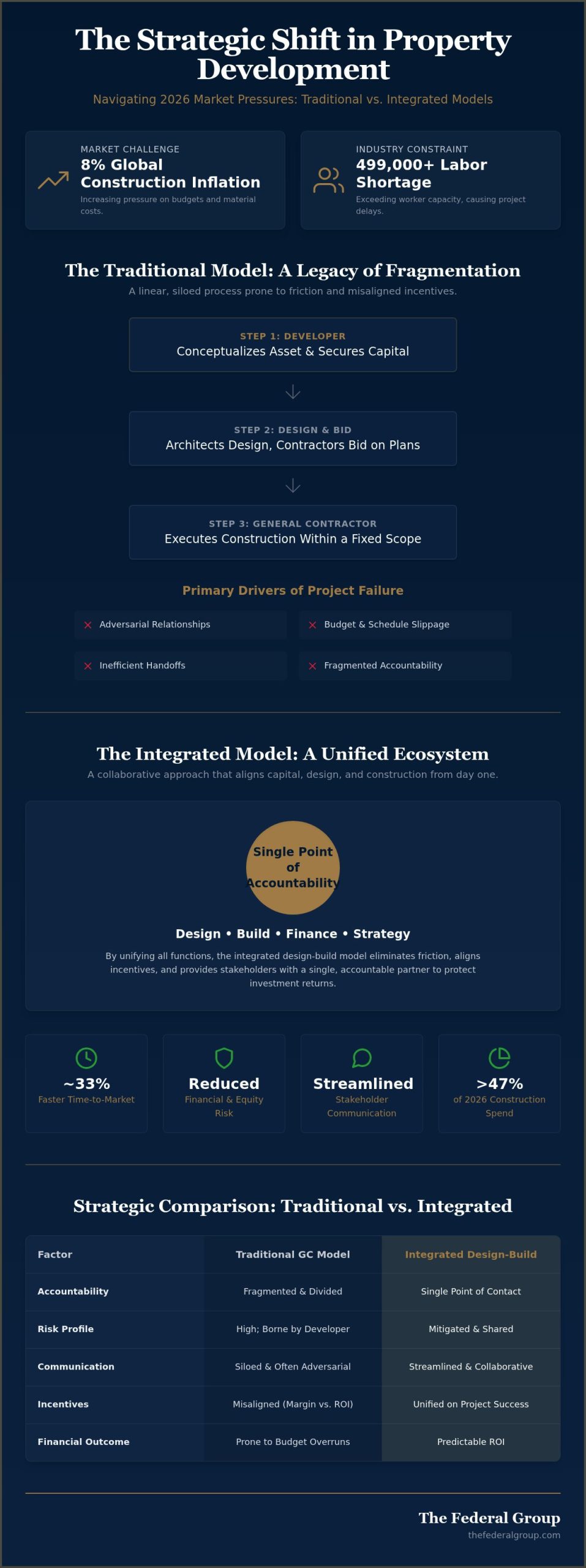
1 September 2026The traditional separation of property developer and general contractor is no longer a strategic choice; it’s a legacy risk that modern capital can no longer afford to carry. As global construction inflation reaches 8% in late 2026 and labor shortages exceed 499,000 workers, the friction between fragmented vendors has become a primary driver of project failure. You’ve likely experienced the frustration of budget slippage caused by misaligned incentives between architects and builders. When evaluating design build vs general contractor for property development, the decision now centers on whether your project structure can withstand the complexities of international regulatory compliance and volatile supply chains.
We recognize that high-value stakeholders require a single point of accountability to protect institutional IRR. This article outlines the strategic shift toward integrated partnerships that unify capital and build teams under a single umbrella. You’ll learn how the 2026 Integrated Standard reduces financial risk, accelerates time-to-market by approximately 33%, and provides the streamlined communication necessary for complex, multi-jurisdictional developments. We’ll preview the transition from fragmented vendor models to the seamless ecosystem approach required for modern global assets.
Key Takeaways
- Define the traditional boundaries between a property development general contractor and the project owner to identify where structural communication breakdowns typically occur.
- Explore why the 2026 market shift favors integrated design-build partnerships to resolve the inherent disconnect between architectural vision and site reality.
- Evaluate the financial implications of design build vs general contractor for property development, focusing on how integrated equity risk improves overall project ROI.
- Establish a framework for assessing international partners based on their ability to navigate regional regulations and provide unified capital solutions.
- Discover how leveraging an ecosystem of development finance and private equity accelerates project timelines and secures institutional-grade assets.
Property Development General Contractor: Defining the Traditional Roles
In the established hierarchy of industrial-scale construction, the general contractor functions as the execution arm of a project’s physical phase. Traditionally, this model operates on a linear trajectory where the developer conceptualizes the asset and the contractor builds it. However, this separation often creates a fragmented environment that struggles under modern economic pressures. When analyzing design build vs general contractor for property development, it’s clear that the traditional model relies on a siloed approach. This can lead to adversarial relationships between build teams and finance teams. Misaligned incentives often arise because the contractor is focused on margin protection within a specific scope, while the developer is focused on long-term investment returns. This tension is a hallmark of the traditional Design-build project delivery system alternative known as design-bid-build.
In the 2026 landscape, these traditional roles face unprecedented pressure. With global construction inflation running at approximately 5% to 8%, the gap between a developer’s budget and a contractor’s actual costs can widen overnight. Fragmentation often causes delayed project starts because of inefficient finance-to-build handoffs. A developer might secure a bridging loan, but if the build team isn’t ready to break ground due to labor shortages, interest costs quickly erode profitability. Choosing between design build vs general contractor for property development requires understanding how these roles interact when they’re kept at arm’s length.
The General Contractor (GC) Scope of Work
A property development general contractor is tasked with the granular realities of the job site. Their primary mandate involves daily management and safety compliance. This is critical for high-stakes industrial projects where liability is a constant concern. They execute. Their work includes sub-contractor procurement and rigorous schedule management to ensure the project doesn’t stall. Within a fixed-price or cost-plus framework, the GC manages material logistics and quality control. They act as the shield between the developer and the chaos of the global supply chain. While they provide the labor and technical expertise, their perspective is often limited to the boundaries of the construction fence.
The Property Developer Scope of Work
The developer operates at the strategic level, focusing on the macro-economics of the asset. Their scope begins with land acquisition and entitlements, but it extends deep into international property development finance. They manage the high-level project vision and coordinate with international stakeholders to secure regulatory approvals across diverse jurisdictions. Unlike the contractor, the developer is responsible for the exit strategy. This includes marketing, leasing, and the eventual divestment of high-value assets. The success of the developer depends on their ability to navigate complex cross-border laws and maintain liquidity throughout the lifecycle of the build.
The Rise of Integrated Design and Build Property Development
The global construction industry is hitting a tipping point. FMI Consulting projects that design-build will account for over 47% of all construction spending in 2026. This shift isn’t merely a trend; it’s a survival strategy for high-value projects facing volatile markets. When comparing design build vs general contractor for property development, the primary advantage of integration is the elimination of friction between architectural intent and construction reality. In a fragmented model, architects often design in a vacuum while contractors bid based on limited data. Integrated design and build developers remove this barrier by fostering collaboration from day one. This collaborative mindset, championed by the Design-Build Institute of America, ensures every square foot is value-engineered before a shovel hits the dirt. Single-source accountability means that if a delay occurs, there’s no finger-pointing between separate firms. One entity owns the outcome.
Federal Holdings: A Model of Integrated Excellence
Federal Holdings exemplifies this shift by managing the entire project lifecycle. We don’t just build. We oversee the transition from the initial architectural concept to the final handover. This internal project management ensures construction quality remains consistent throughout the build, rather than being diluted by disconnected third parties. By overlapping the design and construction phases, we can reduce time-to-market by approximately 33%. This speed is vital for institutional-grade developments where every day of delay translates into significant lost revenue. If you’re looking to de-risk your next project, you might consider how integrated development partnerships provide the stability needed for complex assets.
The Role of Capital in the Build Process
Integration isn’t just about design; it’s about the fusion of construction and capital. A general contractor with direct private equity backing offers a level of stability third-party contractors can’t match. This financial depth allows for the strategic use of bridging finance for land acquisition. Securing a site quickly with internal capital ensures mobilization starts immediately, rather than waiting months for external bank approvals. The synergy between development finance and on-site construction creates a powerful ecosystem. It allows the build team to focus on execution while the capital team manages macro-economic risks. This unified approach turns construction from a risky cost center into a managed asset lifecycle.
Traditional GC vs. Integrated Developer: A Strategic Comparison
The structural disconnect in the debate of design build vs general contractor for property development is most visible in the contract architecture. Traditional general contractors typically operate on Lump Sum or Fixed Price contracts. While this sounds secure, it often creates misaligned incentives. If material costs rise or labor shortages occur, the contractor’s margin is threatened, which can lead to corner-cutting or aggressive change orders. Conversely, integrated developers share the project’s equity risk. This partnership model aligns their financial success directly with the owner’s ROI. Instead of an adversarial relationship, you gain a strategic partner invested in the asset’s long-term performance.
When evaluating design build vs general contractor for property development, the reduction in communication overhead is another critical differentiator. Managing a multi-vendor environment requires significant internal resources to coordinate between the architect, the GC, and the finance team. Single-point accountability eliminates this friction. When one entity manages the entire lifecycle, the “blame game” disappears. The Integrated Advantage represents the strategic fusion of institutional financial stability and construction precision.
Risk Mitigation and Accountability
Integrated models handle change orders more efficiently because the design and build teams share the same profit-and-loss statement. There is no incentive to use a change order as a profit center. The involvement of real estate private equity partners further reinforces project solvency. These partners provide a capital cushion that third-party contractors lack. Additionally, unified corporate group structures often secure better insurance and bonding terms. Insurers recognize the reduced risk profile of a holistic delivery method where financial and operational teams are perfectly aligned.
Speed and Deployment of Capital
The finance-to-field gap is a silent killer of IRR. In traditional developments, construction often stops while waiting for bank drawdowns or external funding approvals. High-value international projects require a development finance lender who understands the technical requirements of the build. Integrated financing allows for immediate capital deployment. In one recent case, this model saved a complex development from a 6-month funding delay caused by a sudden shift in local banking regulations. By bypassing external approval cycles, the project maintained its momentum and met its original completion date.
Evaluating a Property Development Partner for International Projects
Selecting a partner for international assets requires more than a local portfolio review. It demands a deep dive into their global footprint and regulatory dexterity. In 2026, the landscape is shifting quickly. As of August 2026, 26 US states have passed bills restricting foreign property ownership, such as Indiana’s SB 256. Navigating these legal hurdles while managing a build requires a partner who understands both the legal and physical structures. When weighing design build vs general contractor for property development on a global scale, the ability to deploy capital across borders is a primary differentiator. You need a partner who provides a full spectrum of bridging, equity, and debt solutions to maintain momentum in volatile markets. Transparency is equally vital. High-stakes stakeholders require digital project management platforms that offer real-time data and AI-driven insights for off-site oversight.
Cross-Border Property Finance Expertise
Construction standards vary wildly between the US and UK. Philadelphia and Pennsylvania transitioned to the 2021 IBC in 2026, while other regions are adopting 2024 standards with new requirements for tornado loads. A generalist contractor often lacks the bandwidth to track these changes alongside currency hedging and international tax structuring. This is where an international real estate finance partner becomes indispensable. They ensure the project remains compliant and solvent regardless of the jurisdiction. They manage the macro-economic friction so the build team can focus on the site.
Sector-Specific Industrial Knowledge
A generalist GC often struggles with the unique demands of high-stakes sports or mixed-use assets. These projects involve multi-layered stakeholder environments that require more than just technical build skills. They require specialized divisions, such as The Federal Group’s Sports Division, which understands the intricacies of sports multi-club ownership infrastructure. Integrated design and build models excel here by providing a single point of accountability for both the stadium’s physical integrity and the financial structuring behind it. This level of specialization is essential for managing complex, industrial-scale developments where failure isn’t an option. To secure your project’s future, partner with an established global developer who manages the full asset lifecycle.
The Federal Group: Seamless Capital and Construction Integration
The Federal Group positions itself as a cornerstone partner for institutional investors who require more than just a builder. We operate as an integrated ecosystem where Federal Holdings serves as the primary execution engine. When deciding between design build vs general contractor for property development, the choice often hinges on the depth of the partner’s balance sheet. We provide a solution that transcends the limitations of a standard general contractor by unifying private equity, development finance, and on-site construction. This vertical integration ensures that every project phase, from architectural design to the final handover, is managed with a focus on maximizing capital efficiency and reducing operational friction.
Our global perspective allows us to manage institutional-grade developments with a level of stability that fragmented models can’t replicate. We don’t just provide services; we provide a unified corporate structure that absorbs the risks typically passed on to the developer. By controlling the entire lifecycle, we ensure that the project’s financial health is never compromised by misaligned build teams. This institutional approach is designed for stakeholders who prioritize security and ambition in equal measure.
Bridging the Gap Between Finance and Build
Our model eliminates the structural delays that plague traditional construction projects. By leveraging internal resources, we accelerate the project lifecycle from the moment of land acquisition. We deploy bridging loans rapidly to secure international sites, ensuring that mobilization isn’t delayed by external credit cycles. This synergy between finance and field operations allows us to maintain a global perspective. We manage cross-border complexities that typically overwhelm local GCs. Working with a partner that controls the full lifecycle provides a level of security that fragmented vendor models simply can’t offer. It’s a proactive approach to de-risking high-value assets.
Next Steps for High-Value Developers
Navigating the 2026 market requires a partner who understands the intersection of capital and construction. We offer specialized consultations to assess project feasibility and determine the optimal financial structuring for current conditions. Engaging with our integrated Design & Build division allows you to leverage industrial-scale expertise for complex assets, such as mixed-use developments or sports infrastructure. Initiating a strategic partnership with The Federal Group starts with a comprehensive review of your project’s technical and financial requirements. We focus on building long-term value through stability and precision.
- Request a feasibility study for your next international development project.
- Explore our integrated capital solutions, including bridging finance and private equity.
- Connect with our specialized divisions to discuss industrial-scale infrastructure and multi-club ownership.
Securing the Future of Global Development
The evolution of the 2026 Integrated Standard confirms that the traditional separation of finance and field operations is a liability. High-value stakeholders now prioritize models that offer single-source accountability and equity risk alignment. We’ve explored how the choice between design build vs general contractor for property development fundamentally dictates a project’s ability to withstand construction inflation and regulatory shifts. By unifying capital solutions with technical execution, developers can protect their IRR and accelerate delivery in even the most complex international jurisdictions.
The Federal Group provides the institutional stability required for this new era of property development. Through Federal Holdings, we deliver integrated Design & Build expertise backed by robust international capital solutions and bridging finance. Our global reach, supported by specialized Sports and Property divisions, ensures your assets are managed with precision from acquisition to handover. Partner with The Federal Group for Integrated Property Development to secure a strategic advantage in the global market. Your vision deserves the security of a partner that manages every stage of the lifecycle.
Frequently Asked Questions
What is the difference between a general contractor and a property developer?
A property developer is the strategic visionary responsible for land acquisition, entitlements, and capital structuring. They manage the macro-economic risks and the asset’s exit strategy. In contrast, a general contractor is the execution arm tasked with daily site management, labor procurement, and physical construction. While the developer focuses on investment returns, the contractor operates within the specific boundaries of the build’s physical scope and timeline.
Why should I choose an integrated design and build developer over a separate GC?
Choosing an integrated developer eliminates the friction inherent in the design build vs general contractor for property development debate. Integration creates single-source accountability, which prevents the “blame game” between architects and builders when delays occur. This model ensures that architectural intent is perfectly aligned with construction reality from the outset. It typically results in project delivery that is approximately 33% faster than traditional fragmented models.
How does development finance impact the construction timeline?
Internal development finance removes the “finance-to-field” gap that often causes work stoppages. When the capital team and the build team are unified, funding drawdowns are released in direct alignment with site milestones. This synergy allows for immediate material procurement and labor mobilization. It bypasses the lengthy approval cycles of external banks, which can otherwise cause project delays of six months or more in volatile markets.
What are the benefits of bridging loans for property land acquisition?
Bridging loans provide the agility required to secure high-value international sites before competitors can react. These short-term capital solutions allow developers to close on land quickly without waiting for traditional underwriting processes. This speed is essential in 2026, where land-use regulations and market conditions shift rapidly. Securing a site early ensures that the design and entitlement phases begin sooner, accelerating the overall project lifecycle.
Can a property development group also provide private equity?
Institutional-grade entities like The Federal Group operate as both developers and private equity partners. This dual capability allows the group to deploy strategic capital into high-potential ventures while sharing the project’s equity risk. This alignment of interests ensures that the developer is focused on long-term ROI rather than just construction margins. It provides a level of project solvency and financial stability that traditional general contractors cannot match.
How does The Federal Group handle international property projects?
We manage cross-border complexities through a global network that understands diverse regulatory environments and construction standards. Our team handles everything from currency hedging to international tax structuring, ensuring project stability in different jurisdictions. We navigate local hurdles, such as shifting building codes and foreign ownership restrictions, while maintaining a single point of accountability. This global perspective allows us to deliver high-value assets with institutional-grade precision worldwide.
Is an integrated model more expensive than hiring a traditional GC?
While the initial fee structure might seem higher, the total project cost is often 6% to 20% lower due to the reduction in change orders. Traditional contractors often rely on change orders as profit centers, which leads to budget bloat. An integrated model focuses on value engineering throughout the design phase. This proactive approach reduces the hidden costs of communication friction and misaligned incentives, leading to a more efficient investment.
What role does a sports division play in a property development group?
A specialized sports division manages the complex infrastructure needs of professional football clubs and multi-club ownership models. This includes the development of stadiums, elite training facilities, and integrated mixed-use assets. By combining sports-specific expertise with industrial-scale construction, we ensure the physical infrastructure supports both commercial and athletic success. This specialized knowledge is vital for navigating the multi-stakeholder environments typical of global sports ventures.